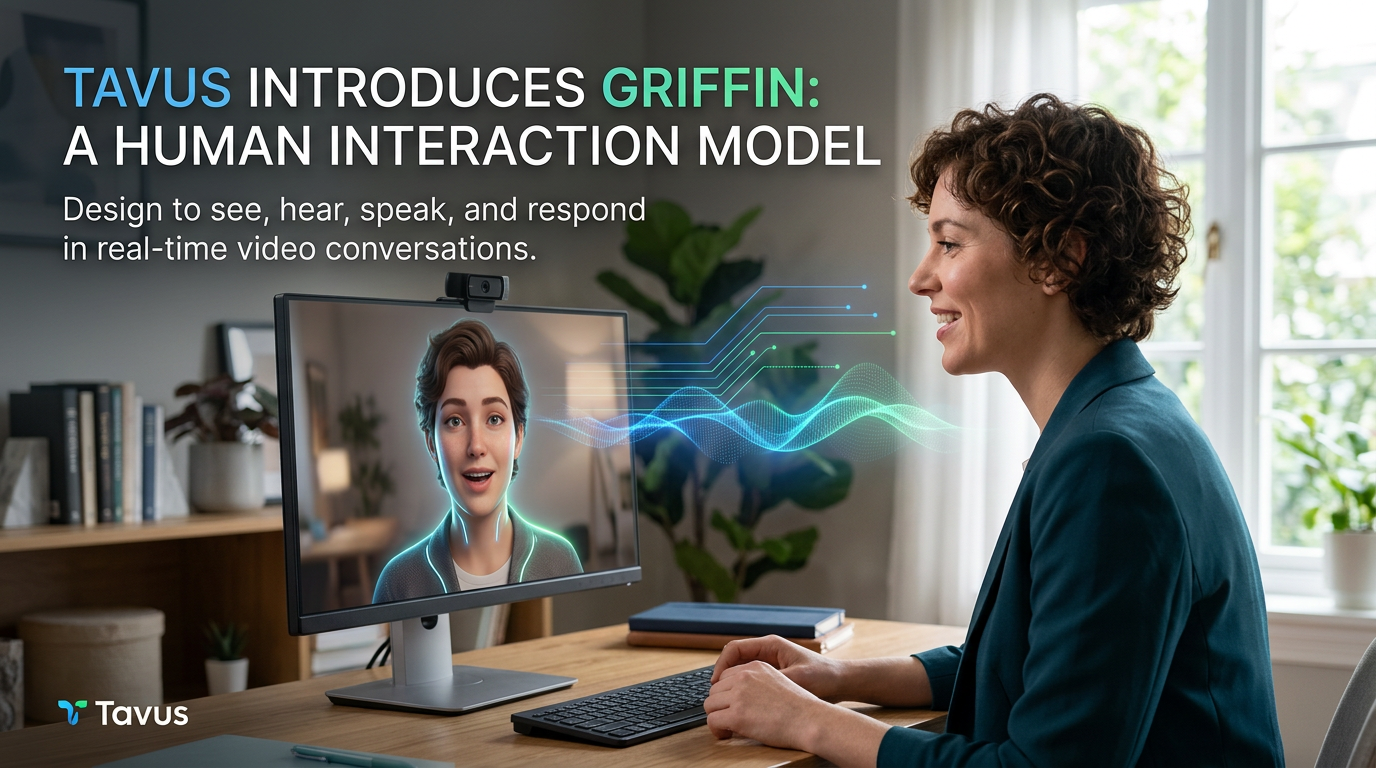
Tavus introduced Griffin on October 1, 2026 as what it calls a Human Interaction Model designed for real-time face-to-face AI conversations. Griffin processes audio and video continuously while responding, aiming to make interaction feel more immediate than systems that wait for a user to finish speaking before generating a response.
What makes Griffin different?
Tavus describes Griffin as a full-duplex video-to-video model. It can see, hear, and respond within the same interaction rather than coordinating separate perception, language, and avatar systems in a simple turn-taking pipeline.
Real-time behavior
The model is designed to react to conversational cues such as pauses and interruptions. That matters because human conversation is not strictly sequential: people begin speaking, stop, change direction, and respond to visual signals continuously.
Early research results
Tavus reports that 48% of participants in a one-minute study believed they had been talking with a real person when interacting with Griffin without knowing what it was. Tavus also reports results from an NVIDIA evaluation. These are company-reported measurements and should be interpreted as early evidence rather than a general measure of human-level interaction.
Availability
Griffin-Lite is being offered as a research preview to a select group of early testers. Tavus says broader release will follow additional safety work.
Potential applications
Real-time video interaction could be useful for education, customer support, simulations, coaching, training, and other experiences where response timing and visual engagement matter. The same capabilities also create requirements around disclosure, consent, privacy, and safe handling of video and audio data.
Practical takeaway: Developers evaluating real-time video AI should test latency, interruption handling, visual grounding, reliability, and user understanding of the AI’s identity—not just how realistic the avatar looks.
Source: Tavus — Introducing Griffin