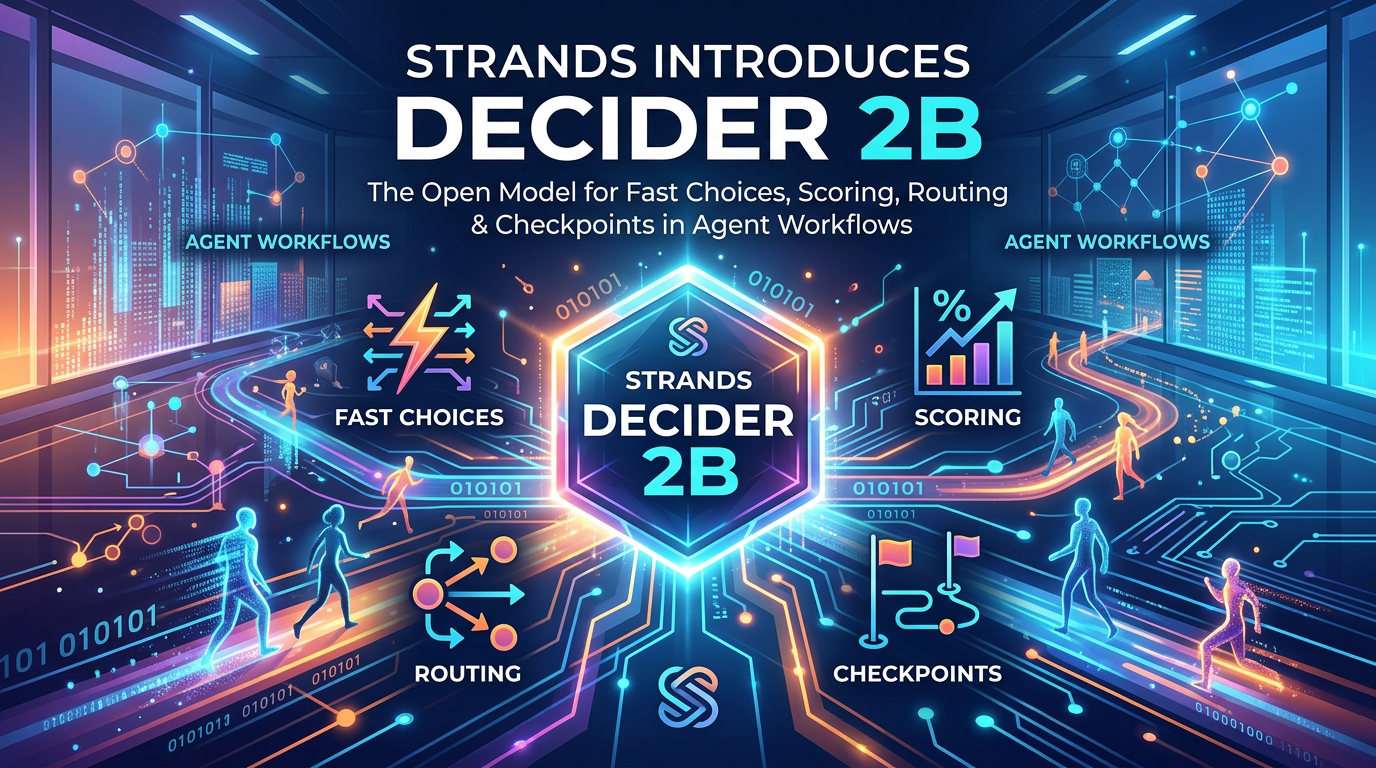
Strands has released Decider 2B, a small open-source decision model designed for fast local inference and agent orchestration. The model is aimed at a narrower problem than a conventional chatbot: selecting among predefined options and producing confidence or reliability information for those decisions.
The release was announced October 1, 2026 as part of the Strands Labs project. Strands describes the model as a tool for experimentation, local development, and agentic AI rather than a replacement for general-purpose language models.
Why a smaller decision model?
Large language models are intentionally flexible. They can write code, summarize documents, reason through problems, and generate arbitrary text. That flexibility also means they can be slower and more expensive than necessary when an application only needs a bounded choice.
Decider 2B takes the opposite approach. A developer supplies a question and a fixed set of possible answers. The model scores those options and returns the decision instead of generating a paragraph of explanation. Strands says this makes the model useful for routing, classification, tool selection, sentiment scoring, and similar operations.
Architecture
The released model contains about 2 billion parameters and is built from a Qwen3.5-2B language-model torso. Strands removed the normal language-model head responsible for token generation and replaced it with a pointer head that scores the available options. A rank-16 LoRA adapter is used for fine-tuning.
This design is important because it explains why the model can operate differently from a normal LLM. It does not need to generate a long sequence of tokens before arriving at an answer. Instead, it evaluates the choices presented to it and produces a structured decision.
Local deployment
Strands says Decider 2B can run on a local CPU or GPU and can return meaningful decisions in tens of milliseconds. The model, training data, and training scripts were released as open-source resources, giving developers a starting point for experimenting with the architecture.
Where it fits in an agent
A practical agent pipeline might use a large reasoning model to understand a user request, then use Decider 2B to select the appropriate tool or workflow. Another use could be checking whether a request falls into one of several operational categories before allowing the agent to continue.
The model can also be useful when an application needs a confidence signal. Strands specifically highlights reliability scoring as a property of decision models. This can provide an additional signal for deciding whether an automated action should continue or be escalated.
Important limitations
Decider 2B is intentionally not a general chatbot. Strands notes that its constrained architecture makes it poorly suited to complex reasoning, coding, summarization, and ordinary conversational generation. Developers should therefore treat it as a component rather than a universal model.
Practical takeaway: For agent builders, Decider 2B is worth evaluating where fast local classification, routing, confidence scoring, or tool selection is required. The most useful comparison is not against a chatbot benchmark alone, but against the latency, cost, and reliability of the model currently making those decisions in your application.