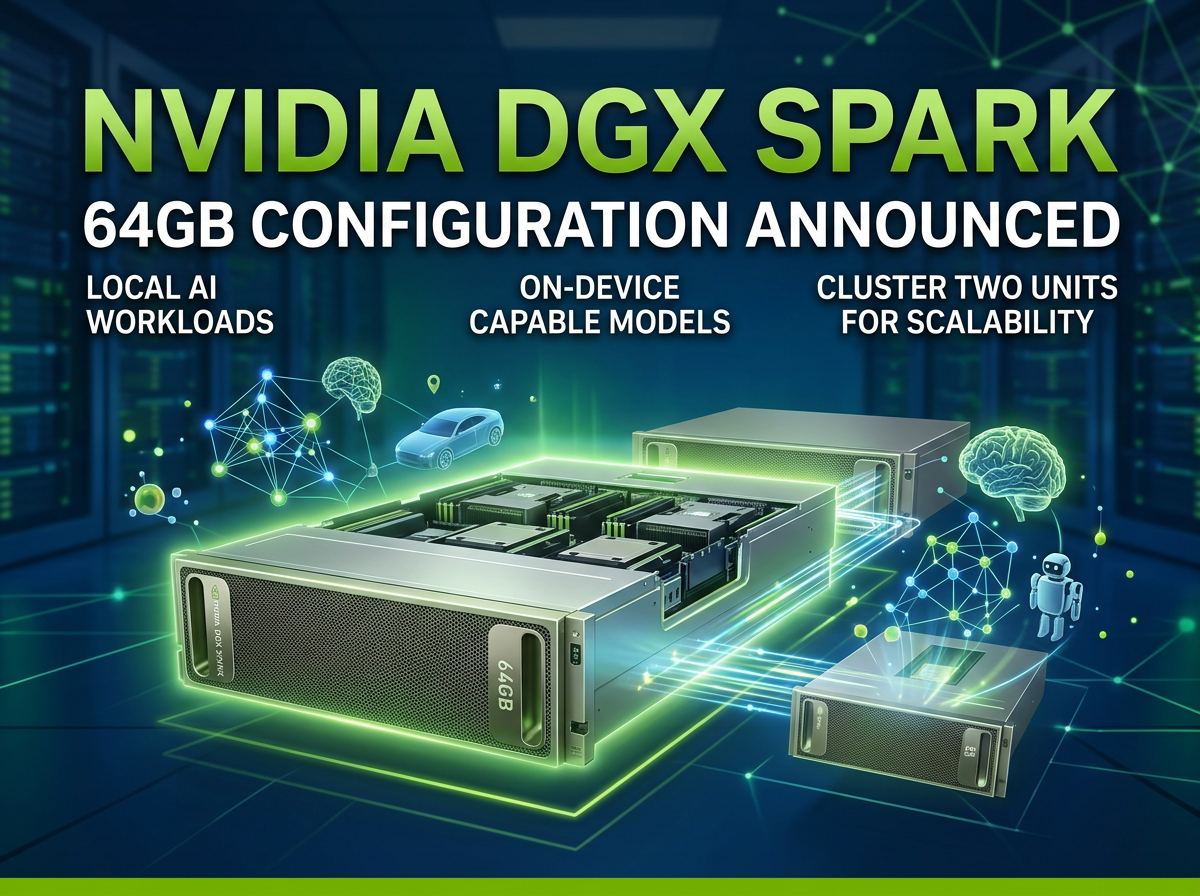
NVIDIA announced a new 64GB unified-memory configuration of DGX Spark on October 2, 2026, aimed at developers and researchers who want to run increasingly capable AI workloads locally. The new configuration is scheduled to become available October 23 through Acer, ASUS, Dell, Gigabyte, HP, and MSI.
What the 64GB configuration adds
The new DGX Spark configuration provides 64GB of unified memory and comes with DGX OS and NVIDIA’s AI software stack. NVIDIA positions the system for local agents and AI development without depending entirely on cloud inference.
Why local AI is growing
Local inference can be useful when data cannot easily leave an organization, when developers want predictable access without network dependency, or when experimentation requires frequent model execution. As open models become more capable, hardware that can run them locally becomes more relevant.
Two-machine clustering
NVIDIA says two DGX Spark systems can be clustered using NVIDIA Sync Cluster Assistant. This provides a path for developers to scale workloads beyond a single device without building a conventional data-center cluster.
Who should consider it?
The platform is aimed at developers, researchers, and AI enthusiasts. It can be useful for model experimentation, local agent development, inference, fine-tuning workflows supported by the hardware, and prototyping applications where privacy or low-latency local execution matters.
Cloud versus local tradeoffs
Local hardware does not eliminate operational costs. Teams still need to account for hardware purchase price, electricity, maintenance, model compatibility, and the opportunity cost of owning capacity that may not be used continuously. Cloud infrastructure can remain more flexible for workloads with highly variable demand.
Practical takeaway: DGX Spark’s 64GB configuration is most interesting for teams that have a clear reason to run AI locally. Benchmark the actual models and workloads you need before deciding whether local hardware is more practical than cloud inference.
Source: NVIDIA Blog