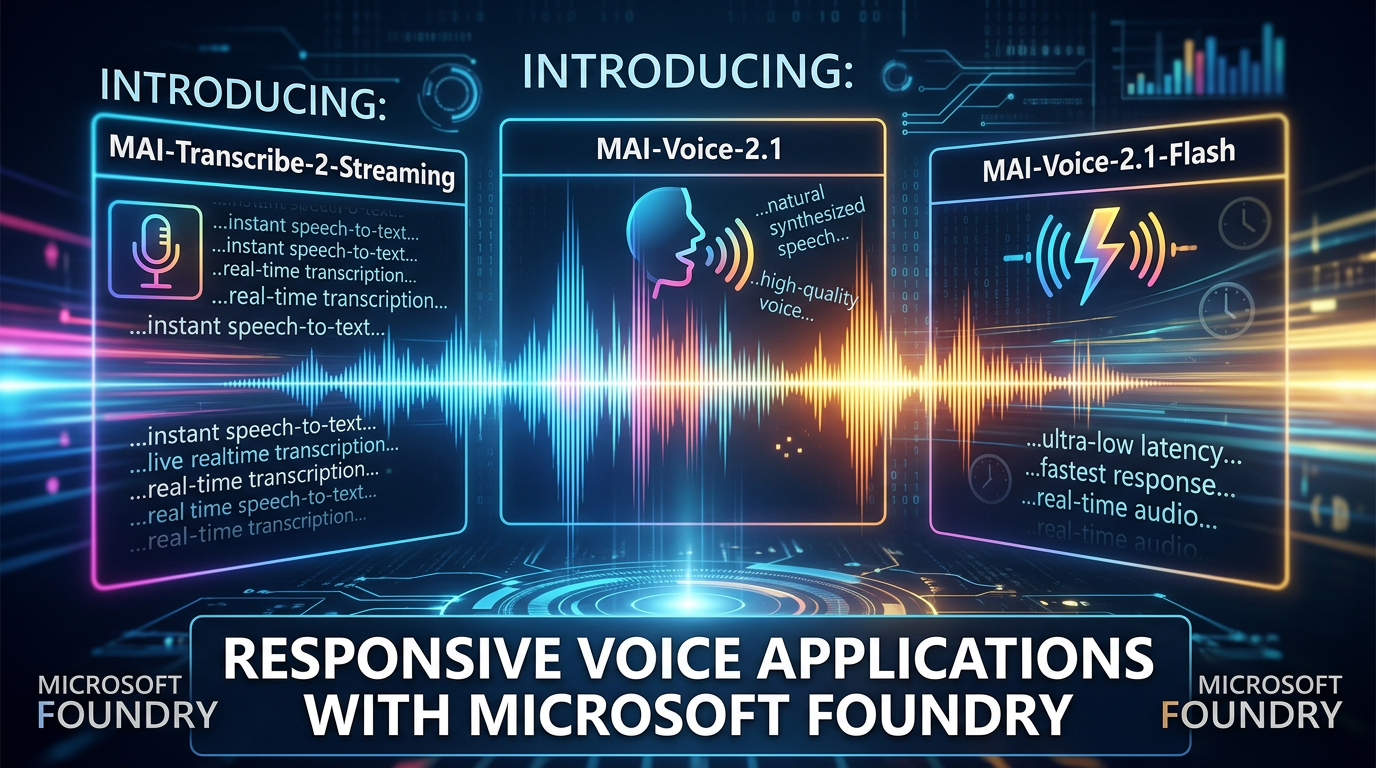
Microsoft has introduced a new group of MAI voice models in Microsoft Foundry, including MAI-Transcribe-2-Streaming, MAI-Voice-2.1, and MAI-Voice-2.1-Flash. The releases focus on responsive speech recognition and voice generation for applications that need real-time interaction.
What was launched?
MAI-Transcribe-2-Streaming is designed for streaming speech-to-text workloads, while MAI-Voice-2.1 and its Flash variant target speech generation. Microsoft is making these models available through its developer platform so teams can integrate voice capabilities into applications.
Why streaming matters
Traditional transcription workflows often wait for an audio segment to finish before returning text. Streaming transcription can produce partial results while someone is still speaking, reducing perceived latency in voice assistants, meetings, call-center systems, and accessibility applications.
Voice generation for interactive systems
Real-time voice generation needs to balance quality with response speed. A voice assistant that sounds natural but waits too long can still feel difficult to use. Microsoft’s Flash-oriented model is intended for scenarios where latency is especially important.
Developer considerations
Voice applications also require careful treatment of permissions, microphone access, personal data, and generated speech. Developers should consider interruption handling, endpoint detection, transcription errors, accent and language coverage, and safeguards against unwanted actions triggered by misrecognition.
Where these models fit
The models can support voice assistants, customer-service applications, transcription systems, interactive media, and other real-time experiences. Their value should be measured through end-to-end conversation latency rather than model latency alone.
Practical takeaway: For teams building voice products, compare transcription accuracy, time-to-first-audio, time-to-first-token, interruption behavior, and total infrastructure cost. A strong voice experience depends on the complete pipeline, not a single model.
Source: Microsoft Foundry and Microsoft AI announcements, October 2026.