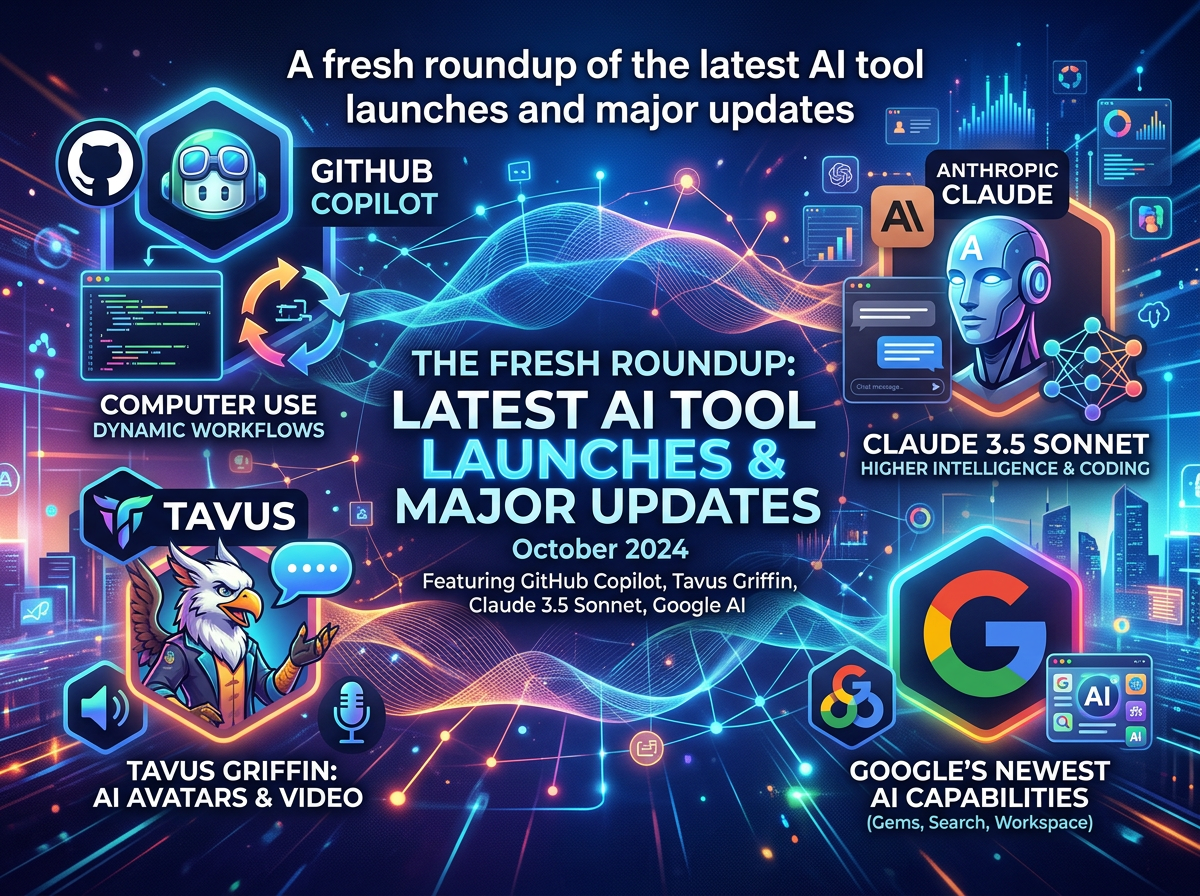
AI tools are moving quickly in October 2026, with new launches and major product updates landing across coding, automation, real-time interaction, and everyday productivity. Here is a practical roundup of notable AI tool updates announced through October 2, 2026, with a focus on what is new and what it means for users.
1. GitHub Copilot Gets Computer Use for Desktop Apps
GitHub announced that Copilot can now interact with desktop applications through computer use. This moves Copilot beyond code and chat into workflows where an agent can operate software through a graphical interface, opening the door to more end-to-end development and automation tasks.
What’s new: Computer-use capabilities are now part of GitHub Copilot, alongside the September VS Code releases and other agent-focused improvements.
2. Dynamic Workflows Arrive in Copilot CLI and the Copilot App
GitHub also listed dynamic workflows for Copilot CLI and the Copilot app in its October 1 releases. AI coding assistants are increasingly being designed to coordinate multi-step work instead of only generating individual snippets or answering questions.
Why it matters: Developers can use agent-style workflows for planning, execution, iteration, and verification across a longer process.
3. Tavus Introduces Griffin, a New Real-Time Human Interaction Model
Tavus introduced Griffin on October 1 as a new Human Interaction Model designed for real-time face-to-face interaction. Griffin processes audio and video continuously while responding, rather than waiting for a person to finish speaking before starting its response.
Current status: Griffin-Lite is available as a research preview to a select group of early testers. Tavus says the broader release will follow additional safety work.
4. Claude Sonnet 5.5 Brings a New Model Upgrade
Anthropic announced Claude Sonnet 5.5 on September 28. The company describes it as a faster and lower-cost upgrade over Sonnet 5, aimed at practical everyday workloads. For developers, model upgrades can affect coding assistants, agent workflows, and API-based AI products.
Developer takeaway: Model availability, speed, cost, and tool-use capabilities are becoming just as important as raw model quality.
5. Google’s September AI Roundup Highlights Gemini 4 Argon and New Apps
Google’s October 2 roundup of its September AI announcements highlights Gemini 4 Argon, new Connected Apps in the Gemini app, natural voice models, and new tools including Googlebook and Gemini for Windows.
What to watch: AI products are expanding from standalone chatbots into connected assistants that can work across applications, devices, voice interfaces, and specialized workflows.
💡 Key Takeaway
The biggest AI-tool shift right now is from simple generation to action: agents are gaining access to desktop apps, dynamic workflows, real-time multimodal interaction, and connected software. For developers and businesses, the most important updates are increasingly about what an AI tool can actually do—not just what it can generate.
Updated: October 2, 2026