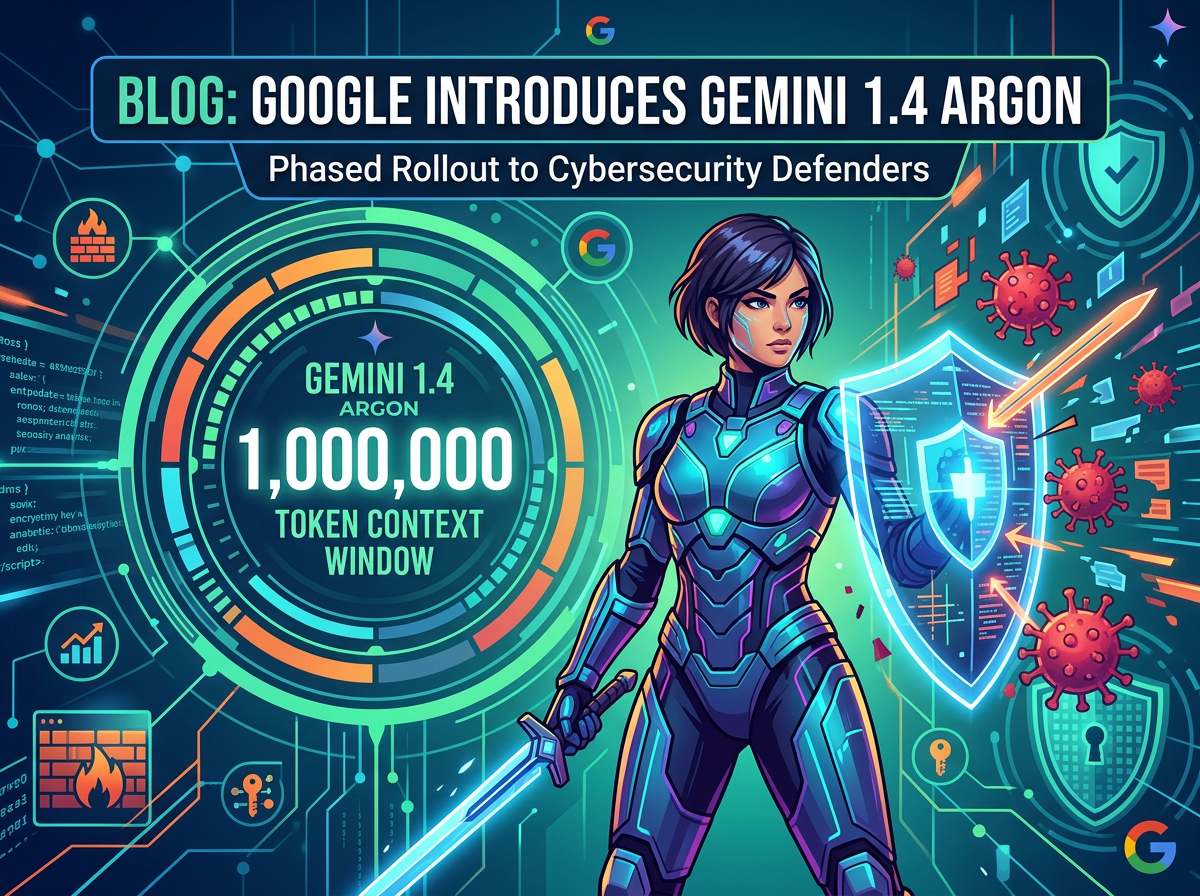
Google introduced Gemini 4 Argon on September 30, 2026 as a frontier model for complex, long-horizon professional work. The model features a 1-million-token context window and is initially being rolled out to trusted cybersecurity defenders through Google’s Fairwind Program.
Long-context reasoning
A 1-million-token context window gives Argon room to process very large collections of information in a single task. Google highlights software engineering, legal and financial knowledge work, and cybersecurity defense as areas where long context and multi-step reasoning can be useful.
Cybersecurity focus
Google says Argon is currently being tested with trusted cyber defenders, including work involving autonomous vulnerability patching. The phased release is intended to gather feedback and improve safeguards before wider availability to developers, enterprises, and consumers.
What long-horizon AI changes
Long-horizon tasks require an AI system to maintain context across many steps rather than producing a single answer. In software engineering, that can mean reading a large codebase, understanding dependencies, making changes, running tests, and responding to failures.
Enterprise implications
Large context windows can reduce the need to manually summarize or split information before sending it to a model. However, organizations still need to consider data governance, access control, cost, latency, and whether every piece of context actually improves the result.
Practical takeaway: Developers should evaluate Argon on complete workflows rather than isolated prompts. For long documents and complex codebases, measure how much context the application actually uses and whether it improves task completion enough to justify the associated cost and complexity.
Source: Google DeepMind — Gemini 4 Argon