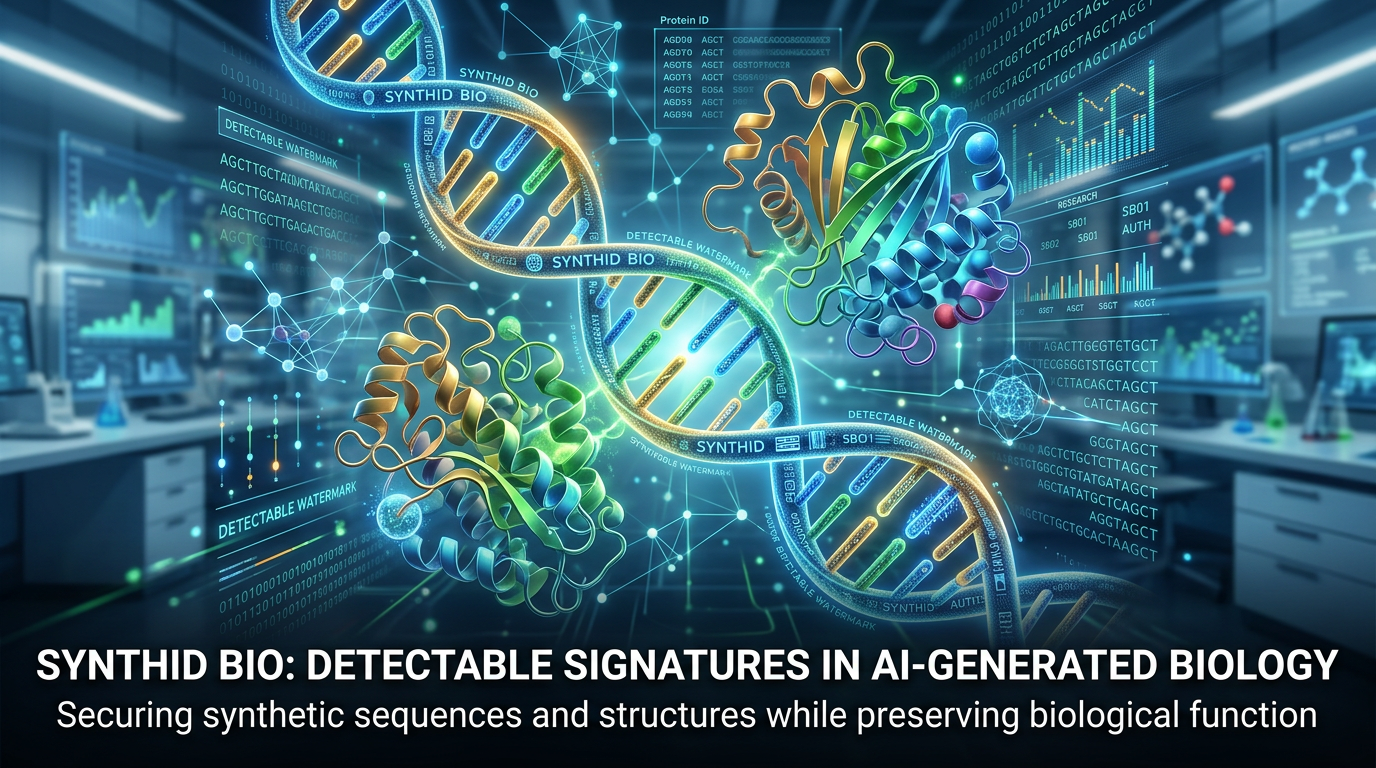
Google DeepMind has introduced SynthID Bio, a watermarking approach designed specifically for AI-generated biological sequences and structures. The project adapts Google’s broader SynthID concept to synthetic biology, with the goal of making AI-generated biological designs identifiable even after they move from a digital model into laboratory synthesis.
Google DeepMind announced SynthID Bio on September 30, 2026. The company describes it as a proof of concept for improving provenance and scientific integrity as generative AI becomes more capable of designing proteins and other biological objects.
Why biological watermarking is different
Watermarking a digital image or audio file is fundamentally different from watermarking a biological sequence. Biological designs can be synthesized, transformed, studied, and represented in different formats. A useful watermark therefore needs to survive a transition from software into physical material while avoiding disruption to the biological function researchers are trying to create.
DeepMind says SynthID Bio embeds an imperceptible signature directly into biological code. For sequences, the technique subtly guides amino-acid choices. For predicted three-dimensional structures, it adjusts atomic coordinates to create a detectable signal.
Testing protein binders
Google DeepMind reports testing the approach on protein binders using AlphaProteo together with a SynthID Bio-enabled version of ProteinMPNN. The company says the watermarking adjustments did not compromise the biological function of the proteins in its laboratory testing.
That distinction is important. A watermark that makes a protein unusable would not be practical for scientific applications. The reported experiments are intended to show that provenance information can be embedded while retaining the properties researchers need.
Potential role in biosecurity and research integrity
Generative biology systems can produce large numbers of novel sequences and structures. Provenance can help researchers distinguish AI-generated designs from other material and can provide additional information when datasets or scientific databases contain generated content.
DeepMind also points to a biosecurity challenge: AI-designed biological sequences can create new screening and tracking questions. Watermarking is not presented as a complete security solution. Instead, the company describes it as one layer that could be combined with metadata, provenance systems, and repositories of AI-generated biological data.
Limitations and future work
DeepMind explicitly notes that robustness against deliberate tampering remains a challenge. This means a watermark should not be treated as proof that a biological artifact is safe or trustworthy by itself. It is better understood as a provenance signal that can complement other controls.
The team is also researching applications to more complex biological objects. DeepMind says it has worked with the Hie Lab at Stanford University and the Arc Institute to integrate SynthID Bio into Evo 2 and watermark the genome of an Evo 2-designed bacteriophage.
Practical takeaway: SynthID Bio illustrates how AI provenance is expanding beyond media files. Researchers and developers working with generative biology should watch watermarking alongside metadata, screening, audit trails, and other provenance mechanisms.