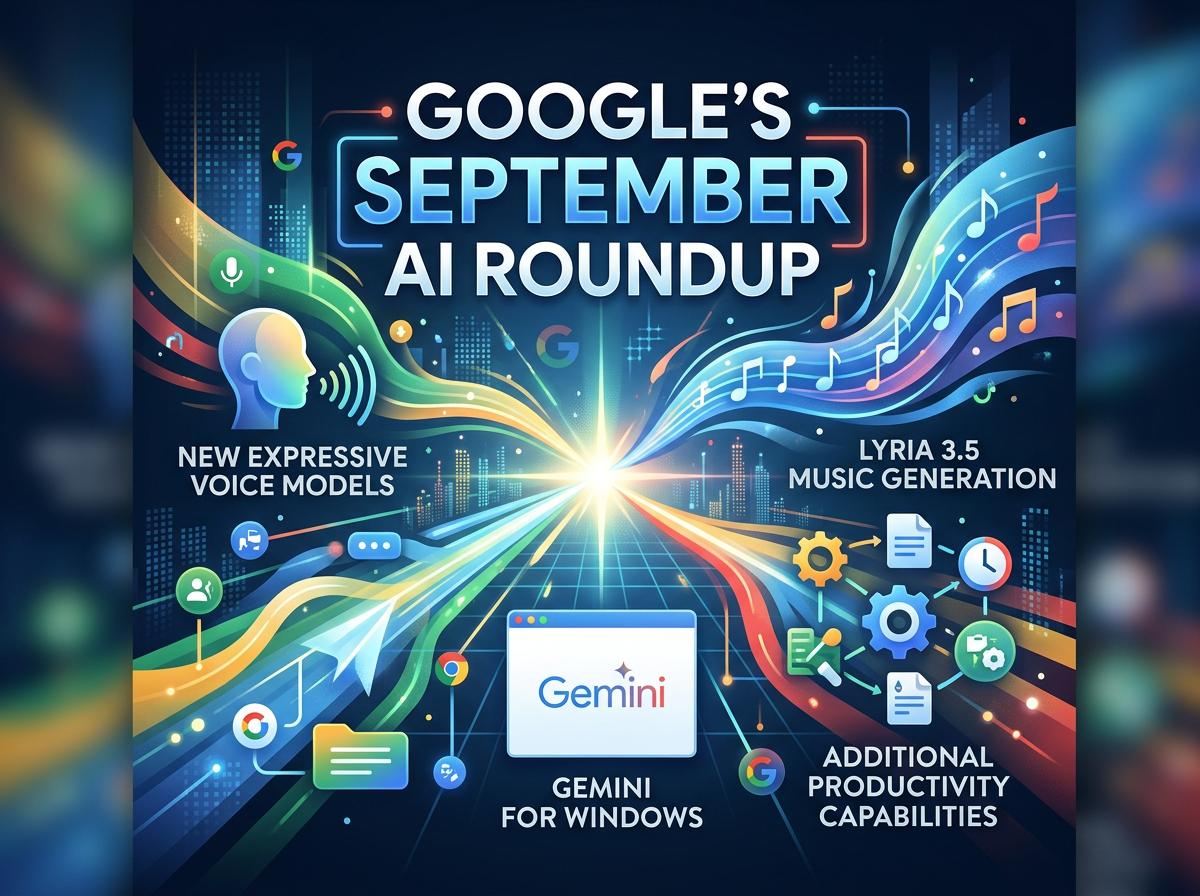
Google’s October 2 roundup summarizes a broad set of AI announcements made during September 2026. The month included Gemini 4 Argon, new voice models, Connected Apps, Lyria 3.5, Gemini for Windows, and several AI-powered scientific initiatives.
Gemini 4 Argon
Gemini 4 Argon is Google’s new frontier model with a 1-million-token context window. Google highlights complex software engineering, financial and legal knowledge work, and cybersecurity defense. Its initial rollout is focused on trusted cyber defenders through the Fairwind Program.
More expressive voice models
Google introduced Gemini 3.8 Flash-Lite TTS and Gemini 3.8 Flash TTS for more expressive text-to-speech. Google describes support for custom voices and directed scene dialogue, expanding the role of voice generation beyond fixed preset voices.
Connected Apps
Gemini gained additional integrations across productivity, creativity, and lifestyle services. These connections let users work with services such as Airtable, Linear, monday.com, Adobe, Webflow, and others without leaving the Gemini interface.
Lyria 3.5
Google also expanded Lyria 3.5, its music-generation model, into Gemini and other Google products. The company says users can create richer arrangements and coherent songs from text prompts or images.
Gemini on Windows
Google also highlighted Gemini for Windows as part of its broader effort to make AI assistance available directly on desktop devices. This reflects the continuing movement from browser-based chat toward assistants that operate across applications and devices.
Practical takeaway: Google’s September releases show a broader product strategy: frontier reasoning, voice, creative generation, connected applications, and desktop access are increasingly being combined into one assistant ecosystem.