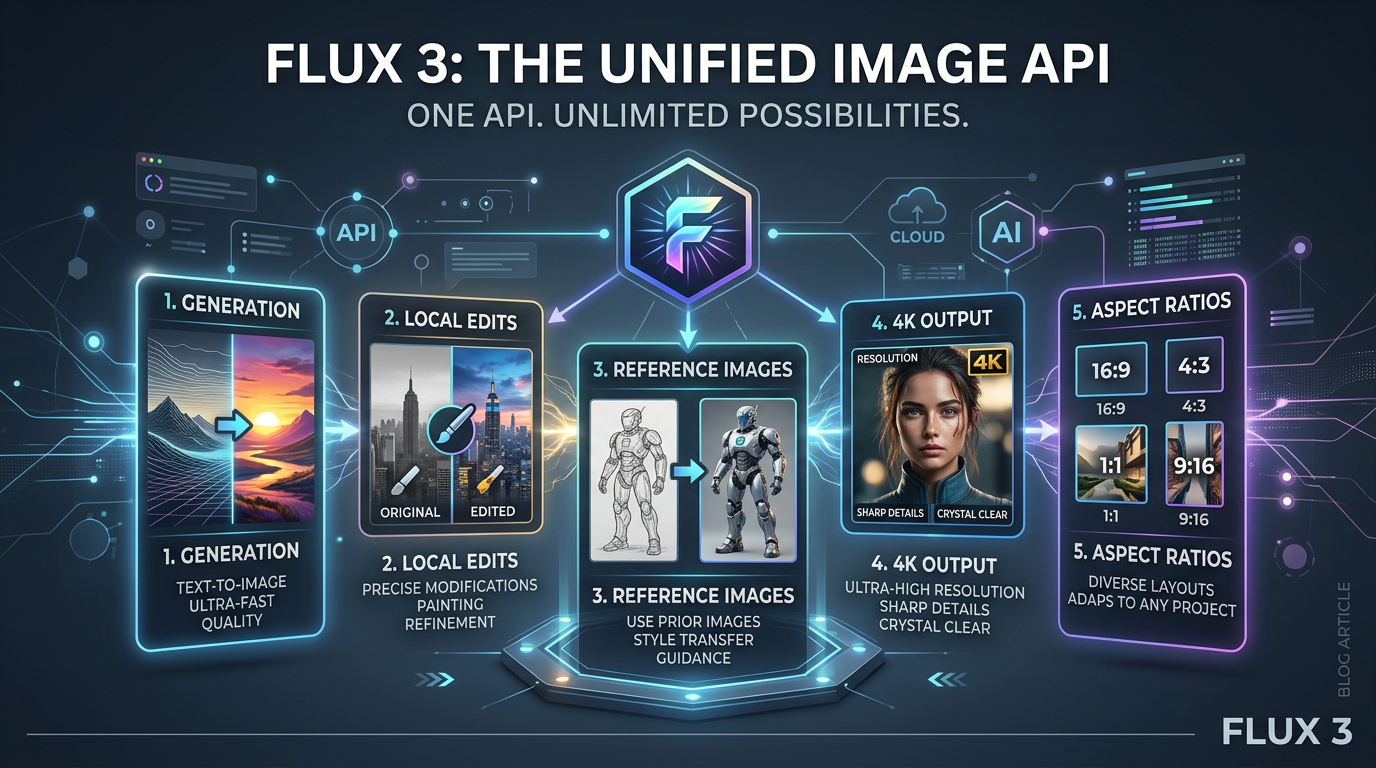
FLUX 3 Image is being positioned as a unified image-generation and editing workflow for developers who need more control than a simple text-to-image prompt. The current release coverage describes generation, local edits, reference-image workflows, multiple aspect ratios, and high-resolution output as part of the same production-oriented API approach.
From generation to editing
Image-generation systems have increasingly moved beyond one-shot prompt-to-image creation. Real applications often need to generate a base image, revise a specific area, preserve a subject from a reference image, or produce the same concept in several formats.
A unified workflow can reduce the need to move assets between separate generation and editing services. For developers, the important question is whether the system can preserve the details that matter across multiple edits rather than simply producing visually attractive first-pass images.
Reference images and consistency
Reference-image support is especially useful for product photography, branded creative, character consistency, and marketing campaigns. Instead of describing every visual attribute from scratch, an application can provide one or more reference images and ask the model to generate a new composition while retaining relevant characteristics.
For production use, teams should test how reliably the system preserves identity, product geometry, typography, colors, and other brand-critical details. Reference support is valuable only when those constraints survive repeated generations.
High-resolution and aspect-ratio workflows
Support for multiple aspect ratios and high-resolution output is relevant to teams producing assets for websites, social media, advertising, mobile applications, and print. A single creative concept may need landscape website banners, square social posts, vertical stories, and other formats.
Developers should evaluate not only maximum resolution but also the practical generation time, output consistency, resizing behavior, and the amount of manual correction required before publication.
What this means for AI product builders
Image generation is increasingly becoming an API capability embedded inside larger products rather than a standalone creative destination. That changes the engineering requirements: developers need predictable APIs, repeatable outputs, editing controls, reference handling, and cost models that work at scale.
Practical takeaway: Teams considering FLUX 3 Image should benchmark it against their actual asset pipeline. Compare first-pass quality, reference consistency, editing accuracy, latency, resolution, and total production cost rather than evaluating image quality from a handful of sample prompts.
Source: Current October 2026 AI release coverage; verify the provider documentation and API terms before production deployment.