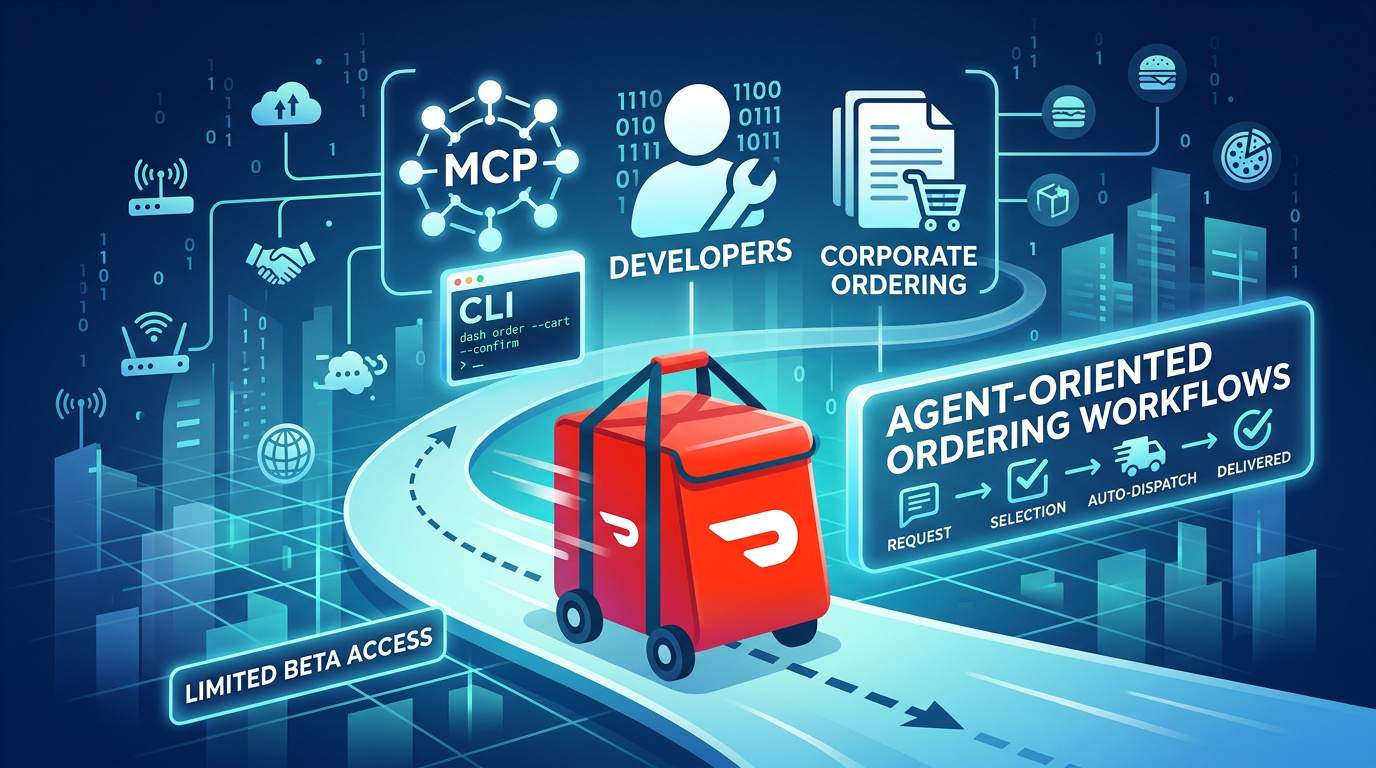
DoorDash has introduced a connector for corporate ordering that lets companies connect DoorDash to compatible internal AI tools and agents. The integration uses the Model Context Protocol (MCP), giving workplace assistants a way to search for items, build carts, place orders, and track deliveries with employee authorization.
DoorDash announced the corporate-ordering connector on September 30, 2026. The company says the feature is beginning as a limited beta for companies and is also expanding beta access to its command-line interface for developers building personal agents.
How the connector works
The central idea is to turn an ordinary workplace request into an agent workflow. For example, an employee could ask an internal assistant to find lunch, coordinate a group order, use an eligible corporate meal benefit, and track the delivery. A workplace bot could also collect individual requests in a Slack thread and handle the ordering steps.
The connector can also support office restocking. A company could connect its inventory system to an agent and allow the agent to identify when supplies are running low, then reorder eligible items through DoorDash.
Why MCP matters
MCP is an open protocol for connecting AI applications to external services. Instead of building a completely custom integration for every agent platform, a service can expose capabilities through a common interface that compatible clients can use.
For developers, the important part is not simply that DoorDash supports MCP. The integration demonstrates a broader direction in which AI agents move from recommending actions to carrying out authorized transactions through external systems.
Authorization and user control
Because ordering involves real-world actions and payments or corporate benefits, access controls matter. DoorDash says company access begins at the organization level, while employees sign in to their own DoorDash accounts and agree to the relevant terms before connecting an agent to act on their behalf.
This model separates organizational enablement from individual authorization. That distinction is important for enterprise agents because a company may allow a capability while still requiring each employee to approve the actions performed under their account.
Early beta and developer access
DoorDash says the initial beta is focused on companies ordering for their own employees. The company is using feedback from participating teams before expanding access. Starting September 30, companies could join the MCP beta waitlist, while developers could request access to the CLI beta through the same developer portal.
What this means for agent builders
Commerce is a useful test case for agentic AI because the workflow combines search, personalization, selection, checkout, authentication, and delivery tracking. Each stage creates opportunities for errors, so production systems need explicit permissions, confirmation steps, audit logs, and safeguards against unintended orders.
Practical takeaway: Developers building workplace agents can study the DoorDash connector as an example of transaction-capable MCP integrations. The key engineering challenge is not just making an API call; it is designing authorization and confirmation flows that keep the user in control of consequential actions.