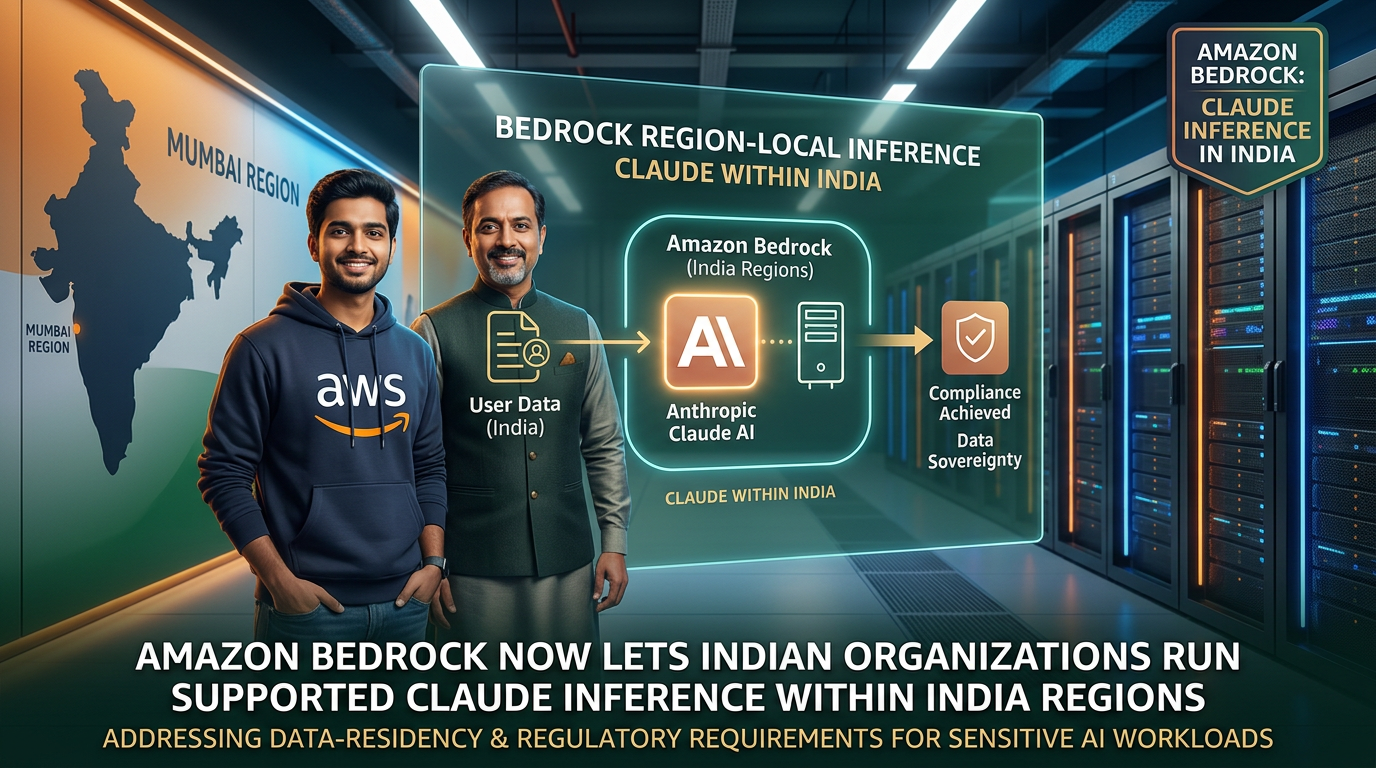
Amazon Bedrock has expanded Anthropic Claude availability to in-country inference in India, giving regulated organizations a way to use supported Claude models while keeping inference within Indian AWS regions. The capability is especially relevant to financial institutions, healthcare organizations, government bodies, and enterprises with strict data-residency requirements.
What changed
AWS announced on September 29, 2026 that Claude Opus 5, Claude Sonnet 5, and Claude Haiku 4.5 are available in India through Amazon Bedrock geographic cross-Region inference. The capability is now receiving renewed attention in the Indian enterprise market as organizations evaluate production AI deployments that cannot rely on processing outside the country.
How India inference works
The India geographic inference profile routes requests between AWS regions in Mumbai and Hyderabad. AWS says requests remain within India while using the broader capacity pool of those regions. This approach is designed to improve resilience and throughput without requiring customers to manage capacity independently in every region.
The feature is available through the Amazon Bedrock runtime endpoint and supports Anthropic’s Messages API as well as the native InvokeModel and Converse APIs. Customers can also combine the models with Bedrock capabilities such as Guardrails and intelligent prompt routing.
Why data residency matters
For regulated organizations, model quality is only one part of the deployment decision. Security teams and compliance departments may require customer data to remain within a defined geography. In-country inference reduces one major barrier to adopting hosted frontier models for sensitive workloads.
What developers should check
Teams should verify the exact regional availability of the model they plan to use, configure the correct geographic inference profile, and understand how cross-Region routing works. AWS notes that prompts and outputs can move between the Mumbai and Hyderabad regions within India. Organizations should also review their own logging, retention, access-control, and regulatory requirements rather than treating regional inference as a complete compliance solution.
Business impact
The change gives Indian enterprises another path between fully self-hosted AI and globally routed cloud inference. Organizations can use managed foundation models, AWS infrastructure, and Bedrock APIs while maintaining an India-only processing boundary for supported workloads.
Practical takeaway
For Indian teams evaluating Claude for production applications, the key question is no longer only whether the model is capable enough. Regional processing, governance, latency, availability, and integration with existing AWS security controls can now be part of the same deployment decision. Start with a workload that has clear data-classification requirements and validate the complete request, logging, and compliance path before scaling.
Sources: AWS — Amazon Bedrock expands Claude model availability to India, South Korea, and Singapore; AWS Machine Learning Blog — In-country Claude inference in India; Express Computer — Claude goes live in India with in-country inference